Showing posts with label Unique Itineraries. Show all posts

Thursday, November 6, 2025

A Wild Tadoba-Pench Itinerary Just For You

Our tiger sighting in Tadoba.

The Tadoba-Andhari Tiger Reserve in Maharashtra and the Pench Tiger Reserve along the Maharashtra-Madhya Pradesh border are two of India's most iconic wildlife destinations! Of course, tigers are their biggest draw! However, these wildernesses are also rich in a plethora of other species and diverse tribal and local cultures. So, if you have a week in hand and wish to explore Tadoba-Pench, here is a perfect itinerary for you. It is tested and tried by me.

Day 1: Reach Nagpur, Maharashtra


  • Nagpur serves as the gateway to numerous national parks and tiger reserves. It is also the nearest major city to Tadoba and Pench Tiger Reserves. The city has its own airport, the Dr. Babasaheb Ambedkar International Airport, that is well-connected to major cities in India. It can also be reached by train or road. If you reach a day earlier, you can stay in the city.
  • Where to stay: Treebo Ivory House; budget-friendly, conveniently located, close to the airport.
  • If you reach Nagpur via a morning flight, you can also take the around three-hour journey to Tadoba on the day itself. In that case, Days 1 and 2 are the same.


Day 2: Nagpur to Tadoba-Andhari Tiger Reserve drive, hotel check-in, afternoon safari at Junona


Inside the beautiful room at Tiger@Ghosri. Image by: Arijit Nag

  • Take a car to Tadoba Tiger Reserve. It takes around three hours to reach Tadoba. Check in at your hotel.
  • Where to stay: Tigress@Ghosri. This property, situated near the Khutwanda Gate (Core) of the Tiger Reserve, has only around six rooms and must be booked in advance. It has beautifully decorated, spacious rooms. The property is located in the wilderness and is visited by tigers, sloth bears, leopards, and other wildlife, especially in the summer months. Guided walks around the property take you to water holes frequented by tigers and other predators. Live camera monitoring of wildlife allows you to watch wildlife activity around the property 24*7 on television from the guest room. Both vegetarian and non-vegetarian food is served, and they are ready to accommodate preferences as per your taste buds. Website: https://www.tigressghosri.com/
On a safari at Junona.
  • If you reach early by around noon, you can plan an afternoon safari at the Junona buffer zone of Tadoba Tiger Reserve. For this, you need to hire a car from Tigress@Ghosri to take you to the safari gate, as it is around half an hour away.
  • After lunch, leave for Junona in the car at around 1:45 pm. Avail the gypsy assigned to you as per the roster maintained by the park authorities at the Junona safari gate. You need to pre-book this before your travel (details and links provided at the end of this article).
  • After completing your safari (timings vary with seasons), return to the property in the pre-booked vehicle once your safari vehicle drops you at the Junona gate.
Watch wildlife live 24*7 through camera footage from the common room. Image credit: Oishimaya Sen Nag

  • In the evening, have a warm cup of tea or coffee while watching wildlife documentaries at the property.
  • Finish your dinner early so you can go to bed early and be ready for a safari in Khutwanda early the next morning.


Day 3: Khutwanda and Moharli wildlife safaris and local cultural exploration.


A giant gaur, the largest bovine on Earth, approaches the road. Image credit: Oishimaya Sen Nag


  • Start from Tigress@Ghosri at around 5:30 am. The safari vehicle arrives at the property itself, as the Khutwanda (Core) Gate is closer to this location.
  • While returning to the safari, request your vehicle driver to take you to a tiger shrine created in memory of people who lost their lives in tiger attacks. These are very interesting, showing how such cultural institutions allow people and tigers to coexist in such landscapes.
Shrines built in memory of a woman and a man who lost their lives in a tiger attack. They were built by their family members to appease the tiger god so that it would not attack others in the future. Image credit: Arijit Nag

  • After returning to the property, take some rest and then have lunch. Start for the Moharli (core) Gate at around 1:45 pm. You again need a pre-booked car for this journey as Moharli is around 30 minutes from Tigress@Ghosri.
  • Return to the property post safari, relax, watch documentaries, and talk to the local staff about their experiences of meeting tigers on foot while going home (many of them have such experiences).
  • Pack your bags and sleep well.


Day 4: Wilderness walk and travel to Rukkhad, Pench Tiger Reserve


Walking near the Tigress@Ghosri property.

  • Wake up around 7 am to take a guided walk around the property. By taking this walk, you are actually treading on tiger territory. You must never take this walk alone, but the property's staff will be with you. Visit the water holes just outside the property where tigers, leopards, sloth bears, and dholes come to quench their thirst, especially in summer. Observe the trees, wildlife footprints, and other signs of wildlife during the walk.
  • Upon returning, enjoy a sumptuous breakfast. After returning to the room, finish up all the remaining packing and leave the property by around 10:30 am to reach the next destination - Rukkhad Jungle Camp in Pench.


Next blog link to be provided soon.


Things to note and costings


The serene forest of Tadoba-Andhari Tiger Reserve. Image credit: Arijit Nag


Website to book Tadoba safaris:

https://safaribooking.mahaforest.gov.in/Regular_booking/index/

Please book as early as possible to get safaris in the desired zones.

Costings (as per October 2025 dates)

Treebo Ivory House: Rs. 3,500/- (including breakfast)

Tigress@Ghosri: Rs. 14,000 per night, including all meals.

Car with driver (from Nagpur hotel near airport to Tigress@Ghosri, travel to and from Junona and Moharli gates, and travel from Tigress@Ghosri to The Bison Retreat, Rukkhad, Pench, all included): Rs. 14,500/-

Safaris (Permit, vehicle, driver, guide): 8,800/- per safari

Tips: as per your wish

Next blog coming up. Link will be provided here.


Non-sponsored Post (based on my recent travel to these places using a personally-crafted itinerary)

Anyone using the content or images without permission will be sued for copyright violation.

Thursday, April 18, 2019

Hassan Tour Day 1 Part 2: Visiting The Hemavathy Reservoir And Dam At Gorur


After our tour of the Hoysala Village Resort as described here, we took some rest in our room and freshened up to prepare ourselves for a short tour of the closest sightseeing destinations near our resort. It was already 3 pm when we set out in a car from the hotel to visit these places.

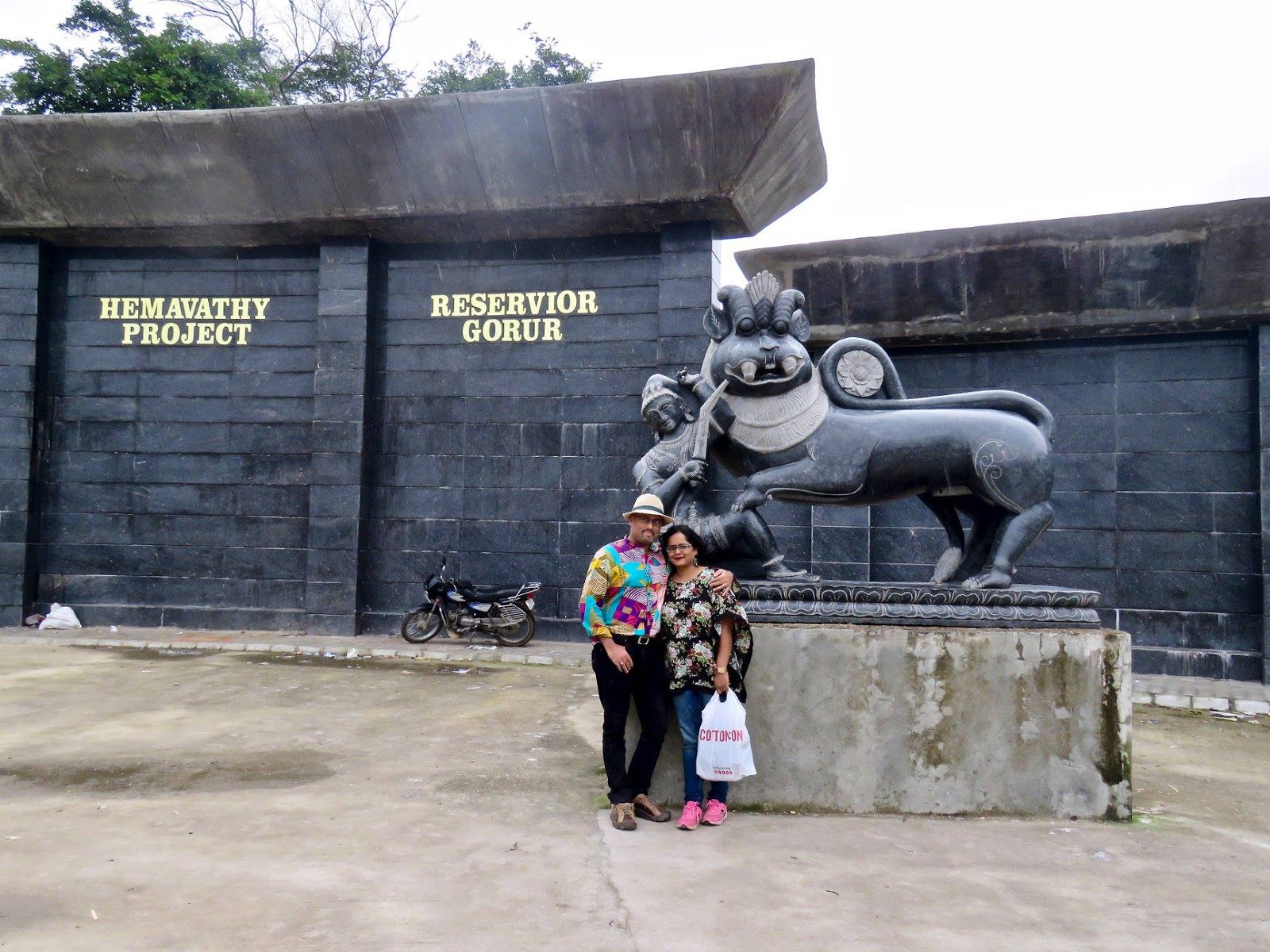
It took about an hour for us to reach the Gorur Hemavathy Dam and Reservoir Project area. Our driver appeared more excited than us to see the dam. After leaving our car in the parking lot, we headed towards the gateway leading to the dam. At the entrance of the project area, was a sculpture of warrior fighting with a lion. Although we admired the sculpture’s beauty, we had no idea of its significance. It was only when we visited the fascinating ancient temples of Belur and Halebidu the next day that we learned about the meaning of the sculpture.


As we entered through the gates, we could see a long stretch of a wide pathway leading to the dam in the distance. By then, it had started drizzling but luckily, we had taken our raincoats with us and that saved our day. The wind was too strong there to use an umbrella. 


In the distance, we could see the foaming white waters of the Hemavathy Dam. Let us learn a bit about the geography of this river and the history of the dam.

The Hemavathy River is a rain-fed river starting in the Western Ghats. It then flows through the Chikmagalur District of Karnataka to enter the Hassan District of the state. Here, the Yagachi River joins it. After that, the river continues to flow into the Mandya district to finally enter the Kaveri River near Krishnarajasagara. The river flows for about 245 km in total and drains an area of about 5,410 square km. 

In 1979, the construction of a dam on this river was completed. The dam was built in Gorur in the Hassan District. It was built just downstream of where the Hemavathy River joined the Yagachi River. The 8502 hectares large Gorur Reservoir was created by the construction of this dam. The Hemavati Dam has a height of 58 m and a length of 4692 m.

As we approached the dam by walking towards it, we admired this human-made mega-structure. However, we also thought of the ill-effects of damming on the region’s wildlife and the displacement of locals. Standing there we realized that dams can be both a blessing and a curse. 

Leaving the dam, our car cruised its way through the tree-lined roadway towards a destination that I was super-excited to see, the Shettihalli Rosary Church.

Read about it here.

1. Hassan Tour Day 1 Part 1: Exploring the Hoysala Village Resort

https://oishimaya.blogspot.com/2019/04/hassan-tour-day-1-part-1-exploring.html

Tuesday, April 9, 2019

Hassan Tour Day 1 Part 1: Exploring The Hoysala Village Resort


It is not always the sightseeing options that are the main attractions of a tour for us. We also love staying in unique and interesting places that have something extra to offer. Thus, when we decided to visit Hassan near Bangalore, we booked a stay at the Hoysala Village Resort that promised a stay amidst nature and experience of Hoysala living styles. 

Hassan is a city in the Hassan district of Karnataka about 3 hours to travel to the city from Bangalore. Hassan is named after the ancient Hasanamba temple. Settlement in the area began as early as the 11th century during the rule of the Hoysala Empire in the region. The resort where we were to stay was about 15 minutes away from the city.

On a fine winter day in 2017, we pre-booked a car to take us from Bangalore to the Hoysala Village Resort. The journey was through good roads and we reached our destination within about 3 hours. 


As we entered the resort, we were welcomed with garlands of marigold flowers and an orange tilak was drawn on our foreheads by a smiling lady of the resort. That was indeed a very Indian welcome ritual that really made us feel special.

After completing the check-in formalities in a beautiful Hoysala-style designed reception building, we were taken by the resort staff to our rooms. As we walked towards our rooms, we got a whiff of what was waiting for us.

The Hoysala Village Resort stretched out before us as a sprawling property with an abundance of greenery everywhere. As we moved through the narrow lanes with flowering plants and tall trees forming canopies over it, we absorbed all the beauty around us.


We had booked our rooms in Superior Cottage. As we approached the cottages, we climbed a few steps to reach our rooms. A large open-air verandah in front of our rooms looked very inviting.

The rooms were sprawling. There was a living room with sofas and a single bed outside. Inside, there was a well-furnished large bedroom a bathroom with an excellent view of the surrounding resort property. The entire setting was very pleasing to the eyes. The lighting of the rooms was also very soothing. The ethnic furniture was all awe-inspiring. 

We could not wait now to explore the rest of the property. We took a quick look around our rooms and asked our guide to take us on a tour of the rest of the resort. 


As we walked on, we were explained that there are three sections to the resort, the Superior Cottages where we staying, the Jacuzzi Villas, and the Malnad Palace. We couldn’t wait to see every part of this beautiful place.

We also noticed that many of the plants around us were labeled to help guests enhance their knowledge in botany. Also, colorful birds and butterflies around us created a lively atmosphere. The place was indeed a bird-watcher’s delight.


The property had several tree houses. Well, not exactly a house, but an open space built on top of a tree where you can enjoy a cup of coffee while watching birds. The jackfruit treehouse was the most fascinating one. We could actually touch and feel the massive jackfruits growing high on the tree.


As we moved on, we came in front of a beautiful building with wide wooden gates decorated with garlands. It was the Malnad Palace, a palatial structure built like the ancient Hoysala palaces of the royals. As we entered the building, a large open-air courtyard surrounded by the two-storeyed building on all three sides greeted our eyes. The pictures below describe what we saw.


Luckily for us, the day before a wedding had been held in the palace and the wedding party members had left, leaving the rooms empty. We requested our guide to show us the rooms which he readily did. We could not contain our excitement to see the rooms of this aesthetically designed palace. 


The rooms were indeed worth seeing. Each room had a unique design and a unique set of furniture. Every furniture piece was worth seeing. Everything was so magnificent that we could not but keep staring at the elegance around us.

We made up our minds that the next time we come here, we must stay at the Malnad Palace.


After exploring the palace to our full content, we exited it to move to the Jacuzzi Villas whose special attractions were the jacuzzis in the bathroom. These villas were also very beautiful and their furniture were all works of art. Greenery enveloped the villas from all sides. Never had the phrase “living in the lap of nature” felt so true as it did when we saw these villas at the Hoysala Village Resort. 

Although I am ending my post here, it is not the end of Day 1 of our visit to Hassan. More will follow soon…

Thursday, March 14, 2019

Manipur Tour Part 5 -Remembering Netaji And Azad Hind Fauz In Manipur


Netaji Subhas Chandra Bose, the great Indian freedom fighter, holds a special place in the hearts of all Indians. Many young men and women of India grow up idolizing him. While more of us relate him with Orissa and West Bengal, places associated with his early life, only a few know that he has also left an imprint of his love for his country in the remote northeastern state of Manipur.

To learn more about the relation between Netaji and Manipur, we traveled to Moirang from Imphal to visit the Indian National Army (INA) complex. 

Moirang is a small town of Manipur located about 45 km away from its capital Imphal. Moirang’s history is intertwined with the history of the Indian Independence Movement in a very special way. 

As our car stopped in front of the INA Complex, we could see a grand statue of Netaji Subhas Chandra Bose standing inside the gates of the complex. After going inside, we were requested to submit our camera and smartphones at a kiosk and then ushered in to visit the museum inside. 

Being big admirers of Netaji, we could not hold back our excitement as we went in humming the tunes of “Kadam kadam badaye ja.”

Let me first brief you a bit on the history of this INA Complex before describing the actual place.

The Indian National Army or the Azad Hind Fauz as it was popularly called, was an armed force established to fight against the British Raj to free India from British rule. The Force was established by Rash Behari Bose, a revolutionary Indian freedom fighter. He later handed over the reins of this Army to Netaji who then led the force. 

On April 14, 1944, the Indian tricolor was unfurled for the first time on liberated soil. Netaji led the INA to defeat the British in Moirang and established a provisional independent government in the area. The flag of independent India was then hoisted in Moirang. 

Today, the INA headquarters in Moirang still stands although it was substantially damaged during a past earthquake. The museum where that we were visiting, however, was located at the spot where the INA members first hoisted the Indian tricolor.

As we wandered through the rooms of the INA museum, we saw many rare and special photographs of Netaji and other notable members of the Azad Hind Force. With the help of these photographs, numerous letters handwritten by Netaji, and other related artifacts we were able to trace the footsteps of Netaji as he bravely conquered all odds to earn freedom for his beloved nation. 

We also saw the map tracing Netaji’s journey in a German submarine for over three months from Germany to Singapore. 

The exhibits at the museum are arranged very wisely to produce imagery before your eyes about the activities of INA in Southeast Asia for the cause of India’s liberation. Netaji’s achievements as the INA leader are also portrayed excellently in the museum. Battles between the British and the INA forces at Imphal and Kohima have also been well-documented at the museum. 

Historians believe that the activities of Netaji and his INA were enough to rattle the British and force them to leave India for good.


As we swelled with pride about the brave sons of the India soil, we came out of the museum and stood at the very spot where the Indian tricolor was hoisted by the INA. It was another emotional moment for us as it reminds us of the immense sacrifices made by Indians for their country’s independence.

Afterward, we also visited the INA Complex Library which is a vast collection of literary works, both fiction and non-fiction, related to Netaji and the INA, India’s struggle for independence, the history of Manipur, and other aspects about Manipur. 

We returned to our car feeling very proud and content.  For all those who have grown up loving and admiring Netaji, we would suggest at least a one-time visit to this INA Museum in Manipur.

Also, Manipur is full of many other wonders which you can explore as mentioned below:

1. Manipur tour-part 1-Kangla Palace

https://oishimaya.blogspot.com/2019/02/manipur-tour-part-1-visit-to-historic.html 
2. Manipur tour-part 2-Shree Govindajee Temple

https://oishimaya.blogspot.com/2019/02/manipur-tour-part-2-visit-to-shree.html


3.  Manipur tour-part 3-Sadu Chiru Waterfall

https://oishimaya.blogspot.com/2019/02/manipur-tour-part-3-visit-to-sadu-chiru.html


4. Manipur tour-part 4-Keibul Lamjao National Park, World's Only Floating National Park


5. Manipur Tour Part 6: The Loktak Lake, A True Marvel Of Manipur


6. Manipur Tour-Part 7: Visiting The World's Oldest Living Polo Ground In Imphal


Monday, March 11, 2019

Manipur Tour Part 4: Visiting The The World’s Only Floating National Park In Manipur

The World’s Only Floating National Park-Keibul Lamjao National Park 


Manipur is a land of secrets and the Keibul Lamjao National Park is just one of them. It is the “World’s Only Floating National Park.” It is just as true as it sounds. It is a national park that floats on the Loktak Lake!

When we visited Manipur, we knew that Loktak Lake was a must-see destination in the state. It is north-east India’s largest lake. We had seen so many images of the lake’s floating phumdis and read about its uniqueness, that it was the biggest attraction of Manipur for us. However, little did we know that there is another secret destination at the southern end of the park that is as fascinating as the lake. It is the Keibul Lamjao National Park.


Surrounded by hills and fishing villages, the Loktak Lake is located about two hours away from Imphal, the capital of Manipur. The lake is known for its phumdis which are floating islands composed of soil and organic matter in various stages of decomposition. Phumdis vary in size and shape and some are stable enough for the construction of small huts on them. These phumdis float on the surface of the Loktak Lake and when viewed from above, appears like rings of vegetation in the blue waters of the lake. 

On the southern end of Loktak Lake, these phumdis have accumulated over centuries to create a large grassy marshland of around 40 square km. The grassland is home to a large number of aquatic, semi-aquatic, and terrestrial species including the Sangai, a subspecies of the Eld’s deer or brow-antlered deer, an endangered species. The Sangai is the state animal of Manipur. It is found only in this marshy grassland of Loktak Lake. It was almost declared extinct in 1951 before it was rediscovered in 1953. 

Recognising the importance of protecting the Sangai’s natural habitat, the government of Manipur declared its homeland as a sanctuary in 1955 which was upgraded to a national park after 22 years. The park was named Keibul Lamjao or the “vast land of the tiger”. Despite the name, no tigers roam the park!


Today, the national park can be easily visited. You need to obtain your permits at the gate of the park and can carry your own vehicle inside the park. We visited the Keibul Lamjao in February. The weather was quite pleasant at that time. We booked a tour from Hotel Imphal to the national park. Once we entered the gates of the park, a guide of the park got into our vehicle and guided us through a low-hilly terrain to the top of a hillock. There, we parked our vehicle and were guided to a watchtower from where we could see the vast expanse of the grassy marshland of the Keibul Lamjao National Park that has an area of 40 square kilometers. 


As our eyes scoured the dense grassy vegetation of the park trying to spot its most prized inhabitant, our guide suddenly burst out in excitement. He pointed his fingers to where he could see the rare and elusive Sangai deer. The animals were so perfectly camouflaged in the vegetation that it took us some time to adjust our eyes to spot not one or two, but three Sangai deer, busy munching the soft grasses of the park. The Sangai, as our guide explained to us, is perfectly adapted to walk on the marshland created by the accumulated phumdis. It requires a phumdi of at least 75 cm thickness to support its weight.


When the guide offered us to take a boat ride through the floating national park, we could not contain our excitement. We climbed down the hillock to where the boats awaited us at the mouth of a narrow canal cutting through the phumdi vegetation. Our guide used a long bamboo pole to manoeuvre the narrow waterway. As we moved on, we observed the phumdi vegetation from up close. We were even provided the opportunity of stepping out of the boat onto the marshland at a place where our guide found it safe to land. It was a unique feeling indeed! The muddy ground below our feet felt a bit wobbly and we could feel the water pressure below. 


As we moved on, our guide explained about the need to save the Sangai. He told us how the natural habitat of the Sangai was in danger due to the flooding of the Loktak Lake because of the construction of Icthai Barrage downstream of the lake. The Forest Department of the Manipur Government worked hard to find a solution to the problem. They used bamboo shafts to pin the phumdis to the ground so that they did not move away and disintegrate due to increased water-levels in Loktak Lake. Their labor bore fruit and the habitat of the Sangai is now safe once more, at least for the time being. 

The Sangai Festival is held every year in November which is one of the best times to visit Manipur and its floating national park. The festival is held to attract tourists to the state and exhibit its natural beauty and rich, cultural heritage on a global platform. 

After our boat ride through the national park and learning about its unique story, we felt very happy that we had decided to visit this park. It is unlike any other national park in the world. Its habitat and inhabitants are all unique. It is truly one of the treasures that the world must conserve. For visitors looking for a new experience and an offbeat destination and also for those who love nature’s myriad forms, a visit to the Keibul Lamjao is a “bucket list must”!

To learn more about tourist destinations in Manipur, please visit:

1. Manipur tour-part 1-Kangla Palace

https://oishimaya.blogspot.com/2019/02/manipur-tour-part-1-visit-to-historic.html 
2. Manipur tour-part 2-Shree Govindajee Temple

https://oishimaya.blogspot.com/2019/02/manipur-tour-part-2-visit-to-shree.html


3.  Manipur tour-part 3-Sadu Chiru Waterfall

https://oishimaya.blogspot.com/2019/02/manipur-tour-part-3-visit-to-sadu-chiru.html

4. Manipur tour-part 5-Remembering Netaji And Azad Hind Fauz In Manipur


5. Manipur Tour Part 6: The Loktak Lake, A True Marvel Of Manipur


6. Manipur Tour-Part 7: Visiting The World's Oldest Living Polo Ground In Imphal